

Are You Reading the Bible Through the Right Lens?

Have you ever read a passage of Scripture and felt completely confident you understood what it meant, only to find out later that you had missed the point entirely? I have. More times than I’d like to admit.
Here’s the thing most of us don’t stop to think about: every time we open our Bibles, we bring a whole invisible backpack of cultural assumptions with us. We grew up in a specific place, in a specific time, shaped by a specific way of seeing the world. And without realizing it, we project all of that onto an ancient text written to people whose world looked nothing like ours.
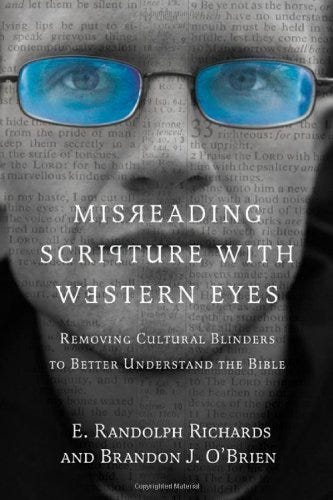
That’s the central challenge that E. Randolph Richards and Brandon J. O’Brien take on in Misreading Scripture with Western Eyes: Removing Cultural Blinders to Better Understand the Bible. It’s a book I’d recommend to just about any Christian who takes Bible reading seriously, and I want to walk you through some of its key ideas because they genuinely changed the way I approach the text.
The Church at Laodicea: A Famous Misread
The book opens with a familiar passage. In Revelation 3, Jesus rebukes the church at Laodicea for being “neither hot nor cold” and threatens to spit them out of his mouth. Most of us have heard a sermon on this: hot means on fire for God, cold means lost, and lukewarm means spiritually complacent. O’Brien explains that he was taught, as were many others, that our leaders and teachers “interpreted the words hot, cold and lukewarm as designations of spiritual commitment.”1 That interpretation has probably been preached in thousands of churches.
There’s just one problem. That’s almost certainly not what Jesus meant.
O’Brien recounts standing in the ruins of ancient Laodicea and suddenly understanding what the original hearers would have known immediately: the city had no water supply of its own. They had to pipe it in. Hot water came from the nearby hot springs at Hierapolis; cold water came from the mountain streams at Colossae. Both were genuinely useful. Both served real purposes. The water that arrived lukewarm, after traveling a long distance through pipes, was the problematic water: tepid, mineral-heavy, and good for very little.
The rebuke isn’t about spiritual temperature. It’s about utility. The church at Laodicea had become useless.
That’s a significant difference. And it only becomes visible when you strip away the assumptions you brought to the text and ask what it meant to the people who first received it. Richards and O’Brien put their finger on exactly this problem when they write that “in whatever place and whatever age people read the Bible, we instinctively draw from our own cultural context to make sense of what we’re reading.”2 Their goal is to help us become aware of that instinct so we can read more carefully. And as they conclude their introduction, they note that their “primary goal is to help us learn to read ourselves.”3
That’s a worthwhile goal, because most of us may subconsciously know we bring biases to the text without realizing just how much of our present culture we’re carrying into biblical interpretation.
The Things That “Go Without Being Said”
Chapter one focuses on what the authors call cultural mores (pronounced mawr-eyz), which are discussed in the book as “views a community considers closed to debate. People don’t think about them as closed to debate; they simply don’t think of them at all. They go without being said.”4
That idea of things that “go without being said” runs through the rest of the book, because it names something we, as Westerners, routinely overlook but that could be of real importance to readers from other times and places. The alcohol example the book uses makes this concrete. O’Brien grew up in a tradition that preached the evils of drinking and used Proverbs 20:1 to back it up. Then he visited a friend from a different denomination and found a wine chiller engraved with a different Bible reference entirely: “Use a little wine for thy stomach’s sake” (1 Tim 5:23 KJV).5 This is the same Bible, but this is a completely different assumption about what the Bible teaches.
As the authors put it, “We might assume that our mores are universal and that Christians everywhere have always felt the way we feel about things.”6 That assumption is exactly the problem. Neither reader thought they were importing a cultural value. Both thought they were simply reading the text. This chapter could have easily been a book on its own, and it sets the tone for everything that follows. Before we can interpret the Bible faithfully, we have to be honest about the invisible glasses we’re already wearing.
Race, Ethnicity, and Reading Between the Lines
Chapter two tackles race and ethnicity. The authors make the pointed observation that “we may assume an issue is due to ethnicity when it isn’t, assume it isn’t when it is, fail to recognize an ethnic slur when it’s obvious or imagine one when it isn’t.”7
A compelling illustration comes from Numbers 12, where Aaron and Miriam speak against Moses because of his Cushite wife. Since Cush was in the southern Nile River Valley, Cushites were dark-skinned Africans, and many Western readers jump to a familiar conclusion. As the authors explain, “We might supply what goes without being said for many Westerners and conclude that Miriam and Aaron were upset with Moses because he married a black woman and therefore married below himself.”8 But that reading projects a modern Western assumption onto the text. At the time, the Hebrews were a slave race. A Cushite wife would have represented marrying up in status, not down. Miriam and Aaron may have been reacting to the perceived social elevation, not to anything about race at all.9
Our cultural moment shapes what we notice. This chapter is a good reminder that faithful interpretation requires us to ask not just “what does this say?” but “what assumptions am I bringing to what it says?” By helping readers understand how their own ethnic stereotypes might shape what they see in the text, Richards and O’Brien offer a genuinely useful tool for reading Scripture more honestly.

Language, Time, and the Distance We Don’t Always Feel
Chapter three makes the important point that translation is only half the battle. Even when we understand the English words, we may be missing the world behind them. Richards and O’Brien put it plainly: “Behind the words, now in a language we understand, remains that complex structure of cultural values, assumptions and habits of mind that does not translate easily, if at all. If we fail to recognize this — and we very often do — we risk misreading the Bible by reading foreign assumptions into it.”10 Their practical recommendation is to read from a variety of translations. A good Bible dictionary or concordance can also fill in gaps that translation alone can’t bridge.
Chapters four and five deal with culture, covering individualism versus collectivism and the contrast between honor/shame and right/wrong frameworks, respectively. One illustration that stuck with me: we tend to imagine writing as a solitary activity, but the authors note that in the ancient world, “Authors commonly stood and dictated while a scribe sat with a sheet of parchment balanced on his knee or in his lap. Paul would not have locked himself away in some private room to write. (It would have been too dark anyway.) He more likely would have sat in a public place: the breezy, well-lit atrium of a prosperous home like Lydia’s, or in an upstairs balconied apartment.”11 That small detail opens up a whole different picture of how the New Testament letters were produced and what kind of communal world they came from.
Honor, Shame, and the Story of David and Bathsheba
This section stopped me cold.
Most Western Christians read the story of David and Bathsheba primarily through a lens of guilt. David sinned. He knew it was wrong. He felt terrible. That’s the moral of the story.
But Richards and O’Brien argue that David was likely operating within an entirely different moral framework: the honor/shame culture of the ancient Near East. Within that system, a king taking a woman for himself and covering his tracks was not unusual. It was, in a disturbing way, normal. “At every step, he did what was typical for a Mediterranean king at the time in a situation like this. And according to the honor/shame system of David’s day, the matter was resolved. It is likely that David never gave it another thought.”12
Now, before you panic: the authors are not excusing David. The point is that God’s moral standard is not determined by cultural norms. David’s behavior may have fit his cultural context and still fallen catastrophically short of God. That’s why God sent Nathan. Nathan didn’t make a legal argument. He told a story designed to publicly shame David, which is exactly the kind of appeal that would have landed in an honor/shame culture. The conviction came through the cultural mechanism David would have understood.
The practical tip here is worth writing down. As Richards and O’Brien advise: “Pay attention to where stories take place in Scripture. If an event or conversation is taking place publicly, there’s a good chance that honor/shame is at stake.”13 The concept of honor and shame, while still prevalent in some Middle Eastern and Eastern cultures, is largely foreign to Western readers. This chapter provides real insight into how that world worked and why we so often misread the people in it.
The discussion of time in chapter six is one I found particularly useful. Biblical writers thought in terms of two kinds of time: chronos (clock or calendar time) and kairos (the weight and significance of a moment). Western readers tend to be deeply chronos-minded. We want to know when something happened, how long it took, and where it fits on a timeline. But the biblical authors were often far more concerned with the kairos: the significance of the moment, not just its sequence. As the authors put it, “We Westerners can focus so much on the time (chronology) that we miss the timing (the meaning of the sequence) in a biblical passage.”14
Rules vs. Relationships
Chapter seven is one I think every Christian should read slowly. Richards and O’Brien argue that because Western readers tend to understand relationships in terms of rules and laws, “we have a tendency also to understand ancient relationships, including those we read about in Scripture, in terms of rules.”15 But in the ancient world, relationships defined reality, not rules.
They illustrate this memorably. Imagine a marriage contract that read something like: “I will kiss you twice daily, with one kiss lasting at least two seconds. I will make at least one statement implying thoughtfulness every morning. I will provide three hugs per week of medium snugness.”16 That’s not love. That’s a checklist. And a checklist, no matter how faithfully followed, cannot substitute for genuine relationship.
So many Christians, if they’re honest, approach their faith the same way. Follow the rules, avoid the sins, check the boxes. What Richards and O’Brien are pointing to is that this is a fundamentally Western misreading of what Christianity is about. The relationship with Christ is the point. The rules, when they appear, exist to protect and describe that relationship, not to replace it.
Virtue, Vice, and What We Quietly Celebrate
Chapter eight opens with the story of the little red hen, who asks her fellow farm animals to help plant seeds, harvest wheat, grind flour, and make dough. At each stage, the other animals decline. When the bread is finally finished and the hen asks who will help her eat it, all the animals are suddenly eager. She tells them plainly: they did none of the work, so they will eat none of the bread.17
In most Western retellings, the hen is the hero. Industriousness is the virtue. Free-riding is the vice. This is illustrated in their stories of teenagers going on mission trips to poorer areas and giving away all their extra clothes to return home with nothing but the clothes they are wearing. Once they return home, they are apalled at how they don’t teat the poor among us the same way as they did in the other country.
But as the authors point out, “the unconscious cultural lessons often influence the way we perceive certain behaviors in Scripture and can lead us to ignore clear biblical teaching on vice and virtue if it challenges a previously held cultural value.”18 That is worth sitting with. The little red hen story teaches a lesson that feels obviously right to most Western readers, but that instinct itself is a cultural formation, not a biblical absolute. Richards and O’Brien ask us to notice when we’re applauding a “virtue” that is more cultural than biblical.

Jeremiah 29:11 and the Promises We’ve Borrowed
The final chapter takes on one of the most quoted verses in modern Christianity: “For I know the plans I have for you, declares the Lord, plans for welfare and not for evil, to give you a future and a hope” (Jeremiah 29:11, ESV).
This verse appears on coffee mugs, graduation cards, and church lobby walls. We apply it personally, confidently, and individually. God has a plan for me.
Richards and O’Brien gently point out that the original recipients of this promise were exiles in Babylon, and the fulfillment was a corporate, generational, decades-long process. The promise is not false. But it was made to a community, not to an individual, and it was not a guarantee of immediate personal blessing. As the authors write, “Western Christians, especially North American Christians, tend to read every scriptural promise, every blessing, as if it necessarily applies to us — to each of us and all of us individually. More to the point, we are confident that us always includes me specifically. And this may not be the case.”19 That assumption shapes what we expect from God and what we feel when life doesn’t deliver accordingly.
How to Read Better
The book’s conclusion offers five practices for becoming more aware of cultural assumptions. Embrace complexity, because the text rewards patience, and the presuppositions we add to it take work to uncover. Beware of overcorrection, since, as the authors note, “We Westerners have a tendency to overcorrect. We’re all-or-nothing sort of people.”20 Be teachable, because the position you arrive at might not be correct, and should be held with enough humility to adjust. Embrace error, since you will misread things, and that is how you learn. And read together, because we need each other to see what we individually miss.
That last one resonates with me deeply. One of the reasons I started Not Forsaken Ministries was the conviction that too many Christians are trying to navigate hard theological questions alone. We were not designed to do this in isolation. The Bible was written to communities, interpreted by communities, and is best understood in community.
As Richards and O’Brien write at the outset of the book: “Before we can be confident we are reading the Bible accurately, we need to understand what assumptions and values we project onto the Bible.”21 That is an accurate statement, and they have spent an entire book helping us do exactly that.
Whether you’re a layperson who loves reading the Bible or someone further along in theological study, this is a book worth your time. It will challenge you, and that is a good thing. I cannot recommend this book highly enough.
If you haven’t read it, you can check it out here: https://amzn.to/4tch6eO
E. Randolph Richards and Brandon J. O’Brien, Misreading Scripture with Western Eyes: Removing Cultural Blinders to Better Understand the Bible (Downers Grove, IL: InterVarsity Press, 2012), 9.
Ibid., 11.
Ibid., 16.
Ibid., 29.
Ibid., 34.
Ibid.
Ibid., 57.
Ibid., 60.
Ibid., 61.
Ibid., 72.
Ibid., 101.
Ibid., 125.
Ibid., 135.
Ibid., 149.
Ibid., 160-161.
Ibid., 173.
Ibid., 177.
Ibid., 179.
Ibid., 193.
Ibid., 213.
Ibid., 16.